

Understanding what makes Argentina’s most iconic grape truly distinctive
Malbec is not just Argentina’s flagship grape. It is a direct expression of landscape, climate, and human decisions made over decades. While Malbec exists in other parts of the world, nowhere has it found the same balance, consistency, and identity as in Argentina. Understanding why requires looking beyond simple tasting notes and into geography, viticulture, and philosophy.
Why Malbec Found Its True Home in Argentina
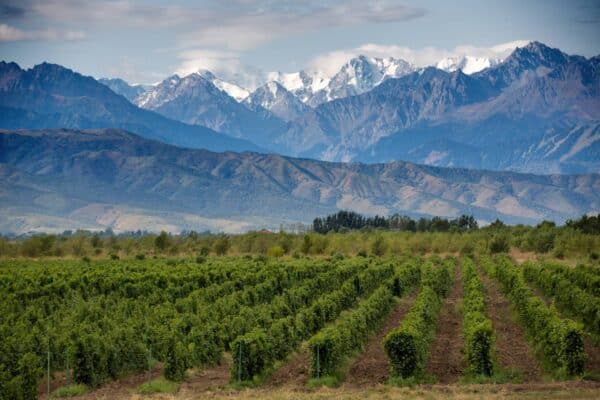
Malbec arrived in Argentina in the mid-19th century, originally brought from France. What happened next was not accidental. Argentina offered conditions that allowed the grape to express itself with clarity and reliability: high-altitude vineyards, intense sunlight, dry climates, and significant temperature swings between day and night.
These factors lead to healthy grapes, even ripening, and natural concentration without excessive alcohol. Unlike wetter regions, Mendoza’s arid climate reduces disease pressure, allowing growers to focus on precision rather than intervention. Over time, Malbec adapted so well that Argentina stopped merely growing the grape and started defining it.
Today, when people think of Malbec, they think of Argentina first—not as a copy of Europe, but as a style with its own logic.
Altitude, Climate, and Style
One of the most misunderstood elements of Argentine Malbec is altitude. Vineyards range from around 800 meters to well above 1,500 meters above sea level. This matters enormously.
At higher altitudes:
- Sunlight is more intense, thickening grape skins and increasing color and tannin quality.
- Nights are cooler, preserving natural acidity.
- Ripening happens slowly, allowing flavor development without heaviness.
This combination explains why Argentine Malbec can be both ripe and fresh at the same time—dark fruit, floral notes, and structure without losing balance.
This is also why Malbec from different sub-regions can taste dramatically different, even within short distances.
Key Malbec Regions in Mendoza
Although Malbec is grown throughout Argentina, Mendoza remains its center of gravity. Within Mendoza, three regions stand out for different reasons.
Luján de Cuyo
Often considered the historic heart of Argentine Malbec, Luján de Cuyo produces wines with round textures, ripe fruit, and a classic profile. These wines tend to be approachable yet age-worthy, combining generosity with structure.
Vale de Uco
Higher altitude, cooler climate, and diverse soils define the Vale de Uco. Here, Malbec shows more tension, precision, and mineral character. Many of Argentina’s most refined and age-worthy wines come from this region, especially from sub-areas like Gualtallary and Altamira.
Maipú
An older, traditional region with deep viticultural roots. Malbec from Maipú often leans toward softer tannins and straightforward fruit expression, reflecting both history and accessibility.
Understanding these differences is essential when talking about high-end wines. Malbec is not one style—it is a spectrum shaped by place.
Malbec and Aging Potential
One outdated idea about Malbec is that it is meant to be drunk young. In reality, well-made Malbec with balanced acidity and proper vineyard management can age exceptionally well.
What allows Malbec to age:
- Natural acidity (especially from higher-altitude vineyards)
- Fine, but present tannins
- Moderate alcohol levels
- Careful oak usage, not dominance
Some of Argentina’s most serious Malbecs evolve gracefully for 10, 15, or even 20 years, gaining complexity rather than losing freshness.
This aging potential is one of the reasons Malbec has earned its place among high-end wines globally.
Argentine Red Wines Beyond Malbec
While Malbec leads the conversation, Argentina’s red wine landscape is broader than many expect. Cabernet Franc, Bonarda, and even old-vine Criolla varieties are gaining attention. However, Malbec remains the clearest lens through which to understand the country’s winemaking identity.
What sets Argentine red wines apart is not experimentation for its own sake, but clarity of expression. The goal is not to imitate Bordeaux or Tuscany, but to let climate and terrain speak with minimal distortion.
Experiencing Malbec at a High-End Level
Reading about Malbec is one thing. Experiencing it properly is another.
At a high level, Malbec is best understood through:
- Visiting vineyards, not just tasting rooms
- Comparing regions side by side
- Tasting with context: altitude, soil, harvest timing
- Talking directly with producers and winemakers
This is where luxury wine tours become relevant—not as a luxury for luxury’s sake, but as a way to access depth, perspective, and authenticity. Small wineries, family projects, and hands-on producers offer insights that cannot be replicated through bottles alone.
At Peter Wine Tours, our focus has always been on private, high-end experiences designed to show how and why these wines exist—not just what they taste like. Understanding Malbec properly requires time, access, and the right context.
Final Thoughts
Malbec is not Argentina’s signature wine by chance. It is the result of geography, patience, and thousands of small decisions made in vineyards and cellars over generations.
To understand Argentine red wines, you start with Malbec. To truly understand Malbec, you have to look beyond labels and into the land itself.

Peter Cubillos, a Mendoza-based writer and winemaker with three published books and over 20 years of experience in wine tourism.